I’m often asked about deities as a tarot reader, and it’s something I’ve always approached in quite a personal and grounded way. So I thought I’d share a little of my own connection, along with some gentle background on a few of the more well known Celtic gods and goddesses.
For me, this has never been about learning a system or getting everything “right”. It’s never felt like that. It’s always been much quieter. More like something you notice over time rather than something you go looking for.
Living in Devon probably has a lot to do with that. There’s a real sense that history sits just beneath the surface here. You don’t have to go searching for it. It’s in the land, the weather, the stillness. There are moments, especially on those quieter days, where everything just feels a little more connected, as if time has softened slightly and something older is still gently present.
That feeling has always sat very naturally alongside tarot for me.
When I read the cards, I’m not trying to force an answer or pin something down. I’m stepping into a flow. Listening, observing, allowing things to unfold rather than trying to control them. And in many ways, that’s exactly how I experience these Celtic energies too.
I spent part of my childhood not far from Glastonbury Tor, and it’s somewhere I still find myself drawn back to now. There’s something about the Tor that stays with you. The quiet, the space, the feeling that so many people have stood there before you, each with their own thoughts and questions.
It’s not dramatic. It doesn’t need to be.
It just… is.
A slightly different way of looking at it
When people ask about deities, there’s often a question sitting quietly underneath it all. How do I connect? What should I be doing? And I always come back to the same thing. You don’t actually need to do very much. It’s not about calling anything in or trying to make something happen. It’s much more about recognising energy, respecting it, and meeting it with a sense of quiet gratitude. No big rituals required. No pressure to get it right. If anything, the simpler you keep it, the more natural it feels. It’s very similar to tarot in that way. You’re not forcing the cards to speak. You’re allowing them to. It’s the same here. You notice what you’re drawn to, you sit with it, and you let it be what it is.
A small but important note
Before I go any further, it’s probably worth saying this. I don’t personally work with all of these energies. I’m aware of them, I understand what they represent, and I can recognise how they show up, but my own connection is much simpler than that. I don’t feel drawn to lots of different deities or move between them. For me, it’s always been Danu. That’s the energy I feel closest to, the one that feels natural and familiar. The others I respect, and I can see why people are drawn to them, but they’re not something I actively connect with in the same way. And I think that’s quite important to say, because it’s very easy to feel as though you should be working with lots of different energies or choosing one in a structured way. In reality, it doesn’t work like that.
People are drawn to different things, and it often happens quite naturally. Some feel a strong connection to Brigid, others to entirely different traditions altogether. My daughter, for example, has a statue of Aphrodite and feels that pull very strongly. That’s her connection, and it suits her perfectly. There isn’t a right or wrong way. It really is a case of you do you…
I’m only sharing the Celtic energies here because they’re the ones that feel closest to me, living where I do and growing up where I did. They feel familiar, almost like part of the landscape. But that doesn’t mean they have to be yours.
The energies themselves
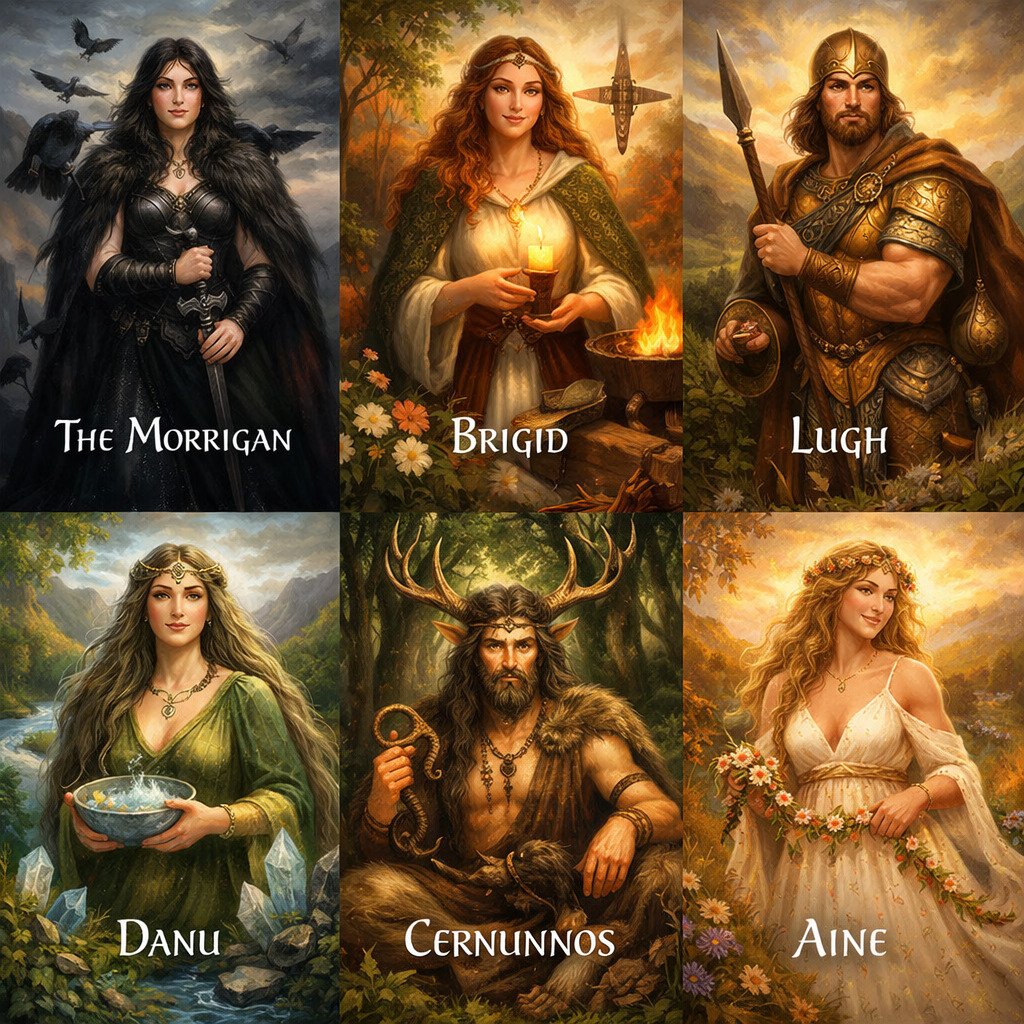
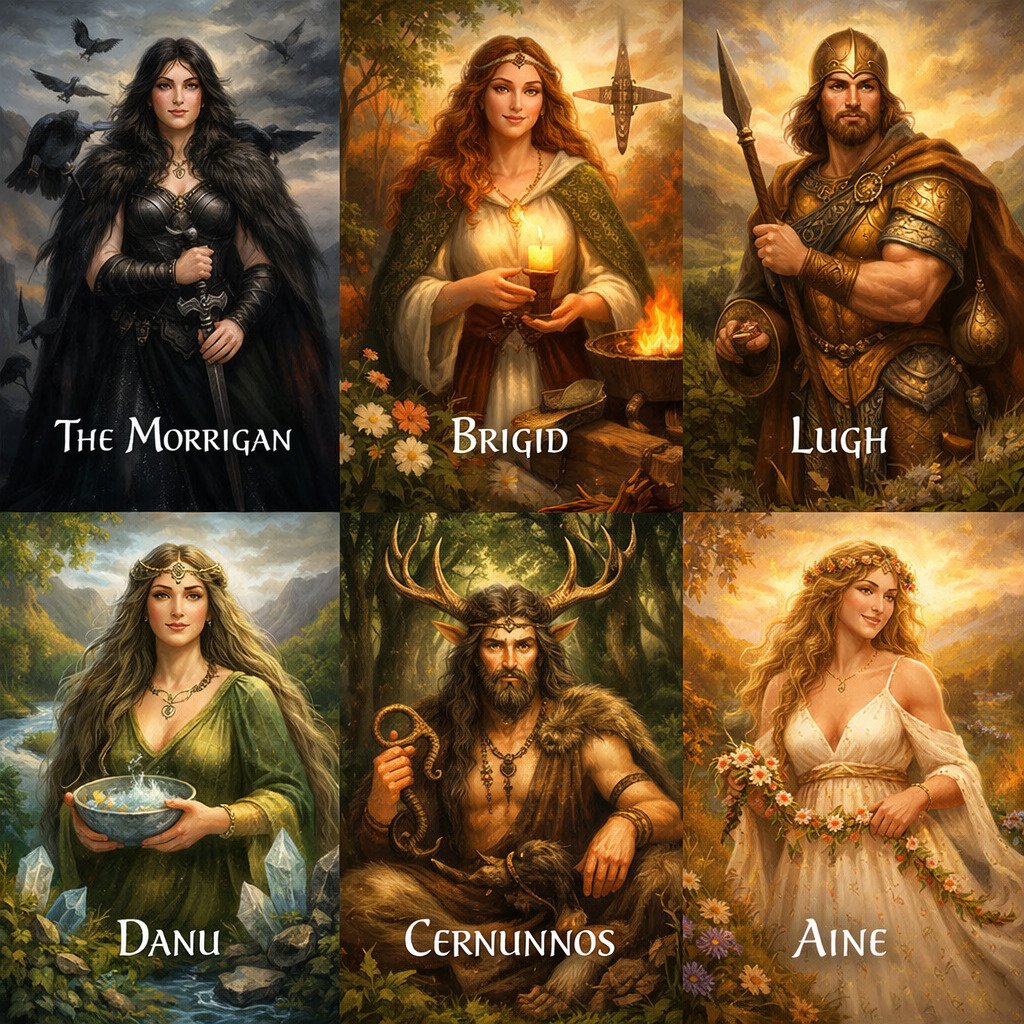
There are many Celtic gods and goddesses, but a few tend to come up more often than others. Not because they’re more important, but simply because their energies are a little easier to recognise.
The Morrigan
The Morrigan can feel quite intense at first. She’s often misunderstood, I think, because people focus on the surface and miss the depth underneath.
She reminds me of those tarot readings where the message is very clear, even if it’s not exactly what you were hoping to hear.
You know the ones.
The kind that gently, or not so gently, bring something to the surface that you already know, but have been avoiding.
Her energy isn’t about fear. It’s about truth. And the strength that comes from facing things as they really are.
Brigid
Brigid feels like a breath of fresh air in comparison. Softer, warmer, a little lighter.
There’s a real sense of gentle renewal with her. Like that moment in a reading where everything suddenly feels a bit clearer and you think, “Ah… okay. I can work with this.”
I can completely understand why so many people feel drawn to her.
Lugh
Lugh has a very steady energy. Quietly confident, not showy at all.
He feels like those moments in tarot where the message is about growth and consistency. Not overnight change, but showing up, learning, improving, and trusting that it all builds over time.
There’s something very grounding about that.
Danu
Danu is the one I feel closest to.
I have a small statue of her on my windowsill by my desk, surrounded by crystals and little bits and pieces that mean something to me. She sits there quietly while I work, while I read, while I create.
There’s no sense of asking for anything. No big moment. She’s just… there.
And there’s something very comforting in that.
It’s a calm, steady kind of support. The sort you don’t question, you just feel.
In tarot, it’s that moment where everything settles and you realise you’re exactly where you need to be, even if things are still unfolding.
Cernunnos
Cernunnos brings everything back to something much simpler.
There’s a reminder in his energy that not everything needs to be analysed or worked out.
Sometimes, things just are.
In tarot, this is the moment where you stop overthinking the cards and just let them speak. And usually, that’s when the message becomes clearest.
Áine
Áine brings a lighter touch.
There’s warmth, a sense of enjoyment, and a reminder that not everything has to be deep or serious all the time.
In tarot, she feels like those readings that gently nudge you to appreciate where you are, rather than constantly focusing on what’s next.
The Dagda
The Dagda has a strong, steady presence. Very grounding.
He feels like those tarot cards that bring you back to what really matters. The practical side of life. Stability, structure, responsibility.
Not always the most exciting message, but often the most helpful.
Where this fits with tarot
For me, none of this feels separate from tarot at all. It all sits in the same space. Tarot isn’t about control. It’s about listening. About stepping into the flow of something that’s already there and allowing it to unfold. These energies feel exactly the same. They’re not something you need to reach out for or try to bring in. They’re already present in different ways. In nature, in experience, in the patterns we move through. Once you start to notice that, everything becomes a lot simpler.
A gentle way to connect
If you’re new to this, it’s very easy to feel like you should be doing more. In reality, less tends to work better. It can be as simple as:
- lighting a candle
- placing something meaningful on your desk
- taking a quiet moment to pause
No big gestures needed. No asking for anything. Just a sense of recognition and respect.
A quiet closing thought
Living in the south west, with so much history around me, and returning often to Glastonbury, it’s hard not to feel that sense of connection. Not in a dramatic or overwhelming way. Just quietly. A feeling that we’re part of something ongoing, something that’s always been there in one form or another. And for me, tarot sits in that same space.
Not separate – just another way of listening.